Independent sourcing partner for Cables & Wiring · factory quotations compared on the same fiber construction, length basis, and destination

DATA HALL

data center fiber optic cable management

Data center fiber optic cable management is a purchase problem as well as a routing problem. Pathways, polarity, jacket, and patch length decide which factory line belongs on the bill of materials.

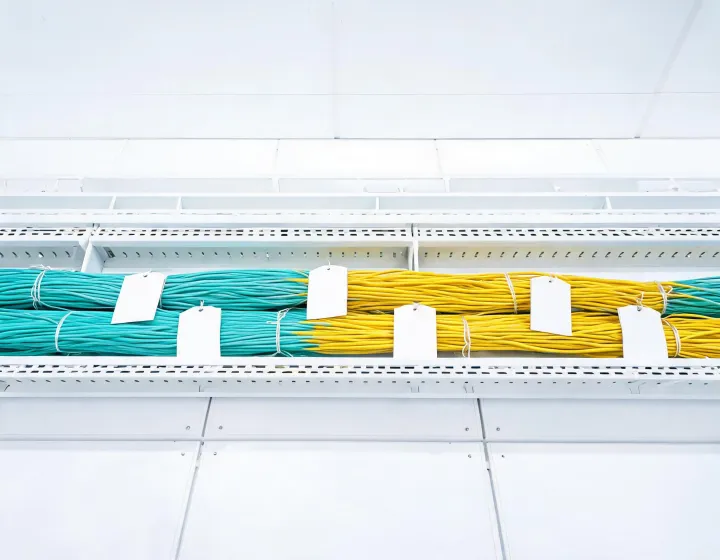
Overhead view of labeled fiber trunks in an open data-hall tray

LinkScope Sourcing 23 does not design the hall. It helps you turn the hall's constraints into questions a factory can price: tray fill, bend, jumper length, and whether the trunk is MPO or a field-spliced distribution cable.

Scope rows for a computer-room fiber buy

Pathway

Overhead tray, underfloor, or in-cabinet. Record the tightest bend the route forces and ask the datasheet for the installed bend radius. A 7.5 mm fiber question and a 10 mm fiber question are different constructions.

Polarity

Method A, Method B, or Method C for MPO trunks. A cassette that flips polarity is not interchangeable with one that does not. Write the method before you compare trunk prices.

Jacket in the hall

Plenum, riser, or LSZH as the room and the authority having jurisdiction require. An outdoor armored reel can be the wrong jacket even when the glass matches.

Patch geometry

Duplex LC at 1 m, 2 m, or 3 m, in 2.0 mm or 3.0 mm, UPC or APC. A management arm that clips a 3.0 mm cord may not clip a 2.0 mm cord the same way. Price them as separate lines.

Evidence to request before the hall accepts a substitute

Single-mode versus multimode inside the room

Single-mode is the side of the argument when the same glass must leave the hall toward a longer campus or carrier handoff, and when 1310 nm or 1550 nm optics are already specified. Multimode is the other side when the runs stay short, the transceivers are 850 nm, and OM4 (or OM3) is what the host ports expect. Mixing a yellow OS2 trunk into an aqua OM4 cassette row is a deviation, not a savings. Optical budget, in dB, still has to be calculated for the chosen pair of optics. This desk does not run that calculation.

Factory trunk versus field termination

A factory MPO trunk can arrive with a loss report on the finished ends and a stated pinout. Field termination can suit an odd route length and a splice case at the entrance. The factory option carries assembly labor in the price. The field option carries consumables, a splice tray, and test time that may sit outside the cable rate. Ask which insertion-loss limit applies, such as 0.35 dB per splice or 0.50 dB per connector, and which party performs the test. Return loss still depends on the polish.

Documents, stages, and site limits

Request the current datasheet, the polarity drawing, and the jacket listing the supplier says applies. Delivery stages to confirm: reel or carton, factory test sheet, on-site inspection, and who signs deviations. Site limits include tray depth, fire rating, and whether a pulling tension in newtons is stated. A TIA premises overview read on 2026-10-27 is a question list for structured cabling. It is not a hall acceptance certificate. Component cards and the brief form are the next practical steps.

Review the hall spec before the rate

Write the host ports, the wavelengths, the quantity of trunks and patches, the US destination, and the timing. Optional budget needs currency and a per-assembly or whole-order basis. A high-end, mid-range, budget, or undecided preference is a buying note, not a factory grade.

Please enter your name.
Please enter a valid work email.
Please enter your company.

Submitting lets the desk review the brief and contact factories. Read the Privacy Policy. Stock, price, compatibility, and compliance stay unconfirmed until a named supplier answers the exact construction.